
Our Latest Articles

What is master keying? a complete guide for 2026
TL;DR:
- Master keying allows a single key to open multiple locks within a hierarchy, offering organizational convenience. It relies on pin tumbler locks with added master wafers that create multiple shear lines, but this decreases pick resistance and increases security risks. Proper, top-down design and secure management of the bitting schedule are essential for system security and efficiency.
Master keying is defined as a locking system where individual keys open specific locks, while a master key opens all locks within a defined group. The industry term for this arrangement is a master key system, and it sits at the heart of access management for hotels, offices, apartment blocks, and schools across Dublin and beyond. Understanding what is master keying means understanding a hierarchy: from the change key that opens one door, up through master keys, grand master keys, and great grand master keys. The system trades a degree of mechanical security for significant organisational convenience, and that trade-off demands careful planning from the outset.
What is master keying and how does it work mechanically?
Master keying works by exploiting the pin tumbler lock mechanism. A standard pin tumbler lock contains a series of spring-loaded pin stacks. Each stack has a key pin at the bottom and a driver pin above it. When the correct key is inserted, every pin stack aligns precisely at the shear line, the gap between the plug and the cylinder housing, allowing the plug to rotate and the lock to open.

Master keying introduces an additional component: the master wafer, also called a spacer pin. This small disc sits between the key pin and the driver pin, creating a second shear point within each chamber. When a change key is inserted, the pins align at the lower shear line. When the master key is inserted, they align at the upper shear line created by the master wafer. Both keys open the same lock, but via different alignment points.
The mathematics here are significant. A 6-pin cylinder can accept up to 64 different keys by adding two shear points in each chamber. That figure illustrates the scale of what a well-designed system can achieve across a large building. Each additional wafer multiplies the number of possible key combinations, which is both the system’s strength and its vulnerability.
| Pin chamber | Without master wafer | With one master wafer |
|---|---|---|
| Shear lines per chamber | 1 | 2 |
| Keys that can open lock | 1 | Up to 2 per chamber |
| Mechanical complexity | Low | Moderate |
| Pick resistance | Higher | Reduced |
Pro Tip: Never add master wafers to more chambers than the system strictly requires. Every additional wafer reduces pick resistance and increases the risk of mechanical wear on short bottom pins.
What are the benefits and security considerations of master key systems?
Master key systems provide organisational efficiency and access management rather than inherently improving a lock’s resistance to forced entry. This distinction matters enormously. A property manager carrying one master key instead of forty individual keys gains real, daily convenience. The locks themselves, however, are not stronger for it.
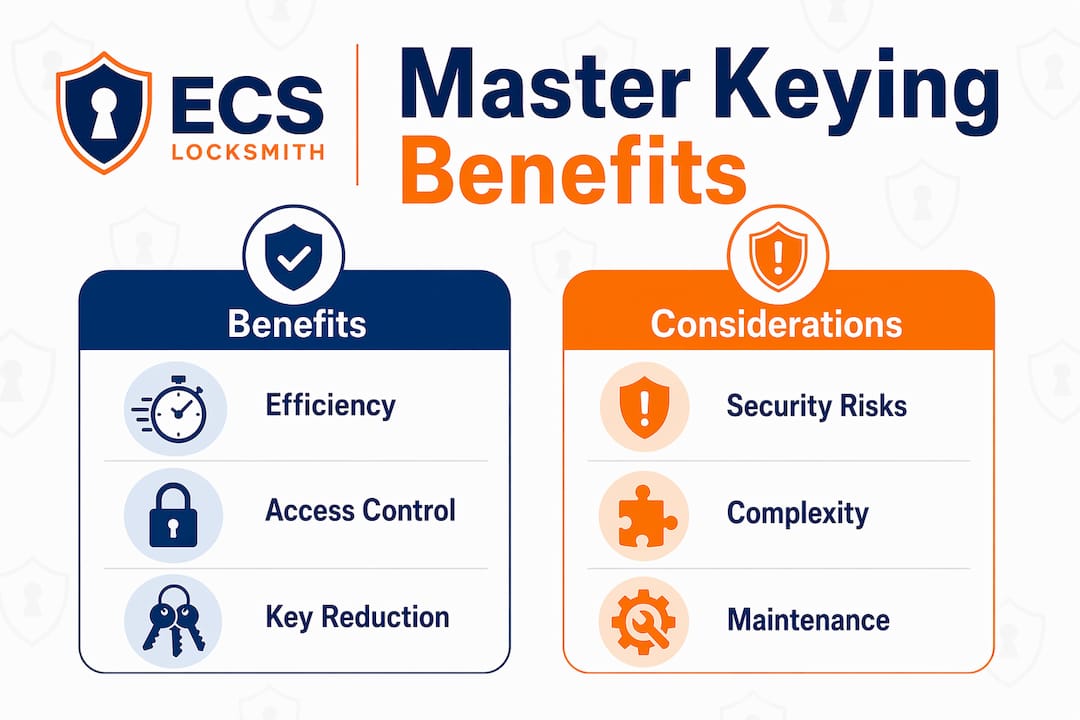
The role of master key systems in large organisations is clear: they reduce key proliferation, define access levels, and allow staff to carry only the keys their role requires. A hotel housekeeper carries a floor master key. The duty manager carries a grand master key. The general manager carries a great grand master key. Each level opens a wider set of doors without needing a separate key for each one.
The security trade-offs are equally clear. Additional master wafers increase vulnerability to picking and bumping, because the extra shear lines give a picker more opportunities to set pins incorrectly and still open the lock. Specialised high-security cylinders with patent-protected keyways can reduce this risk significantly. Brands such as Mul-T-Lock and ASSA Abloy produce cylinders specifically rated for master keyed environments.
Benefits of master key systems:
- Fewer keys to carry and manage across large properties
- Defined access levels that match organisational roles
- Faster emergency access for authorised personnel
- Reduced locksmith call-outs for lost individual keys
- Simpler key auditing when staff leave or change roles
Security risks to manage:
- Increased pick and bump vulnerability due to extra wafers
- Risk of ghost keys opening unintended locks if bitting maths are wrong
- Mechanical wear accelerated by additional pin components
- Loss of a master key compromises multiple locks simultaneously
- Complexity makes system errors harder to detect without professional review
How should a master key system be designed and managed?
Effective master key system design starts at the top. Professional locksmiths stress starting design from the top down with the grand master key to maintain system integrity. Working downward through the hierarchy prevents conflicts in the bitting schedule and reduces the chance of ghost keys appearing later.
A ghost key is an unintended key that opens a lock it should not. Incorrect master keying mathematics can result in security leaks that are difficult to detect without a full audit. The risk grows with every level added to the hierarchy, which is why keeping the structure as flat as possible is the single most important design principle.
The bitting schedule is the document that records every key cut in the system. The bitting schedule should be kept off-site and only available to authorised personnel. Treat it as a security document equivalent to a safe combination. A compromised bitting schedule allows anyone with access to a key-cutting machine to duplicate any key in the system without ever touching the original.
Best practice design steps:
- Define all access levels before cutting a single key
- Start the bitting schedule with the grand master key
- Assign change keys downward through the hierarchy
- Use a restricted or controlled keyway to prevent unauthorised duplication
- Record every key issued, including the recipient’s name and date
- Store the bitting schedule securely off-site with restricted access
- Review and audit the system annually or after any staff change
Adding more hierarchy levels causes an exponential increase in master wafers, degrading pick resistance and increasing mechanical wear. A three-level hierarchy covering change keys, master keys, and one grand master key is sufficient for most commercial properties. Anything deeper than four levels creates more risk than it resolves.
Pro Tip: Most novices design master key systems from the bottom up, assigning individual locks first. This almost always creates bitting conflicts later. Always start with the grand master key and work downward.
What are modern alternatives to mechanical master keying?
Electronic master keying enables dynamic permission changes without physical rekeying. This is the defining advantage of electronic and hybrid access control systems over their mechanical counterparts. When a staff member leaves, their access is revoked in software within seconds. No lock needs to be changed, and no key needs to be recovered.
Electronic systems also generate audit trails. Every access event is logged with a timestamp and a credential identifier. That level of visibility is impossible with mechanical keys and makes electronic systems the preferred choice for high-security commercial environments, data centres, and healthcare facilities.
Mechanical master key systems remain preferable in several situations: where power supply is unreliable, where the property has existing pin tumbler infrastructure, where budget constraints rule out electronic hardware, or where the access hierarchy is simple enough that electronic complexity adds no real benefit.
| Feature | Mechanical master key system | Electronic master key system |
|---|---|---|
| Access changes | Requires physical rekeying | Instant via software |
| Audit trail | None | Full timestamp log |
| Power dependency | None | Requires power source |
| Upfront cost | Lower | Higher |
| Key loss risk | High impact | Low impact |
| Maintenance | Periodic lock servicing | Software and hardware updates |
Hybrid systems combine a mechanical cylinder with an electronic credential layer, typically a smart card or fob. They offer the reliability of mechanical hardware with the flexibility of electronic access management. For most Dublin businesses upgrading an existing mechanical system, a hybrid approach offers the most practical path forward.
Key takeaways
A master key system manages access hierarchy efficiently, but its security depends entirely on disciplined design, flat hierarchies, and secure bitting schedule management.
| Point | Details |
|---|---|
| Master keying defined | One key opens multiple locks; individual keys open only their assigned lock. |
| Mechanical principle | Master wafers create extra shear lines, allowing different keys to operate the same cylinder. |
| Core security trade-off | Extra wafers reduce pick resistance; high-security cylinders help offset this weakness. |
| Design rule | Always design top-down from the grand master key to prevent ghost keys and bitting conflicts. |
| Modern alternative | Electronic systems allow instant access changes and audit trails without physical rekeying. |
Barry’s view on master keying in practice
The most common mistake I see is clients treating a master key system as a security upgrade. It is not. It is an access management tool, and confusing the two leads to poorly designed systems that create more risk than they solve.
The second mistake is hierarchy creep. A client starts with a sensible three-level system, then adds a sub-master for the accounts department, another for the IT room, and suddenly the system has five levels with ghost keys nobody can account for. Flat hierarchies are not a compromise. They are the correct answer for almost every property I have worked on.
The third thing I would stress is key control after installation. A master key system is only as secure as the discipline around it. If master keys are left on desks, lent to contractors, or never audited, the mechanical quality of the cylinders becomes irrelevant. Train your staff, log every key, and review the system every year. If you are unsure whether your current setup is sound, a professional locksmith review will identify problems before they become incidents.
— Barry
How Ecslocksmiths can help with your master key system
Master key systems require precise planning and professional installation to work correctly and securely. Ecslocksmiths designs and installs master key systems in Dublin for residential properties, commercial buildings, and mixed-use developments. The team handles everything from initial access hierarchy planning through to cylinder selection, key cutting, and bitting schedule management.
Whether you need a straightforward two-level system for a small office or a multi-site grand master arrangement for a larger organisation, Ecslocksmiths offers a free consultation to assess your needs. Contact the team directly through the website to arrange a site visit and receive a no-obligation quote tailored to your property.
FAQ
What is a master key system?
A master key system is a locking arrangement where individual keys open specific locks and a master key opens all locks within a defined group. The system uses a hierarchical structure ranging from change keys up to grand master keys.
How does master keying work inside the lock?
Master keying works by inserting small master wafers into pin tumbler cylinders to create additional shear lines. Different keys align the pins at different shear points, allowing more than one key to open the same lock.
Does master keying make locks more secure?
Master keying does not improve a lock’s resistance to forced entry or picking. It manages access hierarchy efficiently, but the additional master wafers can actually reduce pick resistance compared to a standard pin tumbler lock.
What is a ghost key in a master key system?
A ghost key is an unintended key that can open a lock it was never designed to open. Ghost keys result from errors in the bitting schedule mathematics and are a known risk when master key systems are poorly designed or over-engineered.
When should I choose an electronic system over a mechanical master key system?
Choose an electronic system when you need instant access changes, audit trails, or when key loss poses a high security risk. Mechanical systems remain practical for simpler access hierarchies, existing infrastructure, or where power supply is unreliable.
What services do locksmiths in Ireland actually offer?
It’s more than just unlocking doors. Most locksmiths provide:
Emergency lockouts (home, car, business)
Lock repairs and replacements
Key cutting and rekeying
Security upgrades (e.g. anti-snap locks)
Car key replacement
How quickly can you respond to an emergency?
In emergency situations, typical arrival times should be at your location within 20-30 minutes. There are always professional locksmiths on standby, ready to handle any lockout or security emergency, ensuring safety is never compromised.
Can a lockmsith help with high-security locks and systems?
Absolutely! Most locksmiths specialise in advanced high-security lock systems, including electronic locks, biometric security, smart locks, and keyless entry systems. The should be trained in the latest security technologies, ensuring that they can provide the highest level of protection for your home, office, or vehicle. Ask for a free expert consultation to help you choose the right security system for your needs.
Will a locksmith provide a warranty on there services?
Yes, all locksmiths should stand by the quality of there work and offer a 100% satisfaction guarantee. Most would by default offer a warranty on all services, ensuring that you receive the best craftsmanship and long-lasting results.
Can a locksmith open Cars
Yes, most locksmiths are trained to open cars.
How quickly can a locksmith get to me in an emergency?
Most locksmiths in Ireland offer 24/7 emergency callouts and typically arrive within 15–60 minutes, depending on your location and traffic. In Dublin, response times can be as fast as 10–30 minutes, especially for emergency lockouts.
Can a locksmith open my door without damaging it?
Yes A professional locksmiths use non-destructive entry methods first. Drilling is usually a last resort, not the default approach.
If someone immediately suggests drilling without inspecting the lock, that’s a red flag.
How much does a locksmith cost?
Costs vary depending on the service, time of day, and complexity of the job. A standard lockout is usually cheaper than replacing a lock. Emergency or late-night services may cost more.
Prices vary, but here’s a realistic guide:
Standard callout/labour: €85–€95
Lockout service: from ~€85–€120+
Lock replacement: depends on parts + labour
Important: Always ask for a full quote upfront and if there is a call out fee. Some companies advertise low prices but increase costs after arriving.
Prices can vary quite a bit… call around for quotes!
Can you make a key without the original?
Yes A professional locksmiths use non-destructive methods whenever possible. Damage usually only happens if the lock is faulty, high-security, or has already been tampered with.
Do locksmiths in Ireland need to be licensed?
Yes. In Ireland, all locksmiths must be licensed by the Private Security Authority (PSA).
If you’re hiring someone:
Ask for their PSA licence number
Avoid anyone who can’t prove credentials
By asking for the licence you avoid the scammers.
Providing Locksmith Services For More Than 30 Years in Dublin, lock outs, lock fitting, slam locks, car opening, commerical and domestic.


Quick Links
Home
About Us
Services
Testimonial
Faqs
Legal
Privacy Policy
Terms & Conditions