
Our Latest Articles
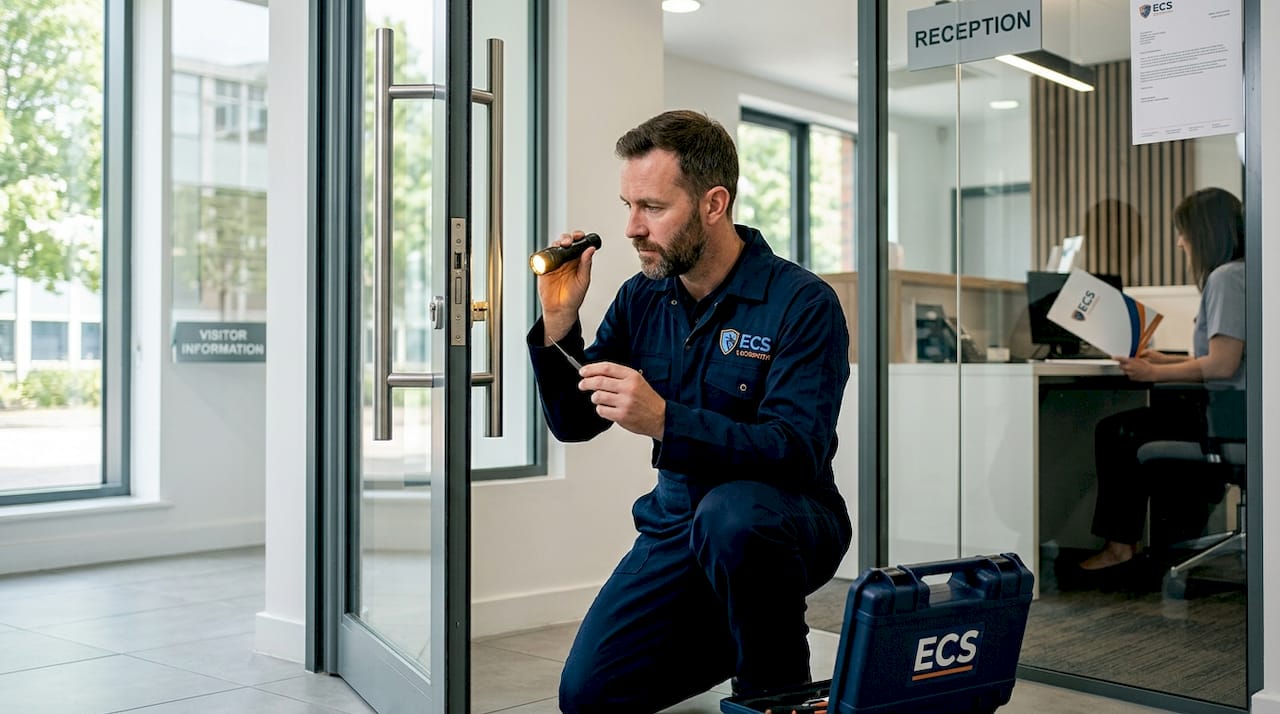
Why maintain commercial door locks: a guide for businesses
TL;DR:
- Neglecting commercial door lock maintenance creates security gaps, compliance issues, and safety risks that can lead to costly failures.
- Routine inspections, timely servicing, and professional upkeep extend lock lifespan, ensure regulatory compliance, and protect staff safety.
Commercial door locks are not something you install and forget. Yet that is exactly how most business owners treat them, and it is one of the most avoidable security mistakes you can make. Understanding why maintain commercial door locks matters goes well beyond preventing a jammed key on a Monday morning. It touches on staff safety, regulatory compliance, insurance liability, and the kind of security failure that does not announce itself until a break-in has already happened. This article covers the real risks of neglect, what the law requires, and what a practical maintenance routine actually looks like.
Table of Contents
- Key takeaways
- Why maintain commercial door locks: the security case
- Safety, compliance, and what the law actually requires
- Extending lock lifespan through regular servicing
- Lock types and what maintenance each requires
- Practical steps for building a maintenance routine
- My view on why this keeps getting overlooked
- Keep your commercial locks in expert hands
- FAQ
Key takeaways
| Point | Details |
|---|---|
| Neglect creates security gaps | Worn or sticking locks leave entry points exposed, increasing the risk of unauthorised access. |
| Compliance is ongoing | NFPA 101 and building codes require egress hardware to remain functional, not just installed correctly. |
| Maintenance extends lock lifespan | Routine servicing every 6 to 12 months prevents premature failure and costly emergency repairs. |
| Electronic locks need specialist attention | Access control systems require software checks, backup power testing, and wiring inspections. |
| Proactive upkeep saves money | Preventive maintenance consistently costs less than reactive emergency callouts and lock replacements. |
Why maintain commercial door locks: the security case
The most immediate reason to maintain your locks is straightforward. A lock that does not work reliably is not a lock. It is a false sense of security.
Routine inspections prevent doors from failing to latch or sticking under load, both of which leave entry points exposed without any obvious sign that something is wrong. The danger is that staff may compensate by propping doors open, manually monitoring access, or wedging locks shut. These workarounds create operational burdens and compound the security risk rather than addressing it.
Common warning signs that a commercial lock is heading towards failure include:
- Keys that stick, turn stiffly, or require force to withdraw
- Doors that do not latch cleanly on the first push
- Visible corrosion, discolouration, or physical damage to the lock body
- A latch bolt that moves sluggishly or does not retract fully
- Electronic locks that fail to respond, display error codes, or delay entry
Each of these symptoms points to a lock that could fail completely under stress, which is exactly when you need it most. A door that holds during a quiet afternoon may not hold at 2am when someone is applying deliberate force.
Access control systems add another layer of vulnerability. Electronic lock failures can cause either denied access for authorised staff or, worse, an unsecured door that anyone can push open. Neither outcome is acceptable in a commercial setting.
Pro Tip: Walk every external and internal secure door at least once a month and test the latch, the lock cylinder, and the electronic response if applicable. You will catch deterioration before it becomes a failure.
Safety, compliance, and what the law actually requires
Security is about keeping threats out. Safety is about getting people out when there is an emergency. Both depend on your locks working correctly, and both are subject to regulation.
NFPA 101 requires that doors in designated means of egress release safely with only permitted locking arrangements. This is not a one-time installation standard. It is an ongoing operational requirement, meaning your egress hardware must be maintained and tested regularly to remain compliant. Installing the correct panic bar in 2019 does not satisfy your compliance obligation in 2026 if that hardware has not been serviced since.
The specific requirements for panic and emergency exit hardware are more detailed than most property managers realise:
- Panic devices must operate with a single motion. No secondary action such as turning a knob or pulling a handle should be required to release the door.
- Release force must not exceed 15 pounds, as specified under IBC 1010.2.9.
- Mounting height for the crossbar or push pad must fall within the prescribed range to be accessible to all occupants, including those with limited mobility.
- Delayed egress systems, where fitted, must include audible alarms and may not delay release beyond 15 seconds under most code conditions.
- Supplemental locks must not be added to panic-equipped egress doors. This is a code prohibition, not a recommendation.
“Panic hardware must be regularly verified beyond appearance to meet specific release force and mounting height standards to remain code compliant.” — US Made Supply
The compliance implications extend beyond fire safety. If a building inspector finds non-compliant egress hardware, you face code violations, potential closure orders, and insurance complications. Insurers increasingly scrutinise maintenance records when processing claims involving break-ins or fire incidents. A gap in your maintenance history is a gap in your defence.
Understanding compliance in facilities management as a continuous process rather than a box-ticking exercise is the mindset shift that separates businesses that stay compliant from those that find out they are not during an audit.
Extending lock lifespan through regular servicing
Commercial door locks face conditions that residential hardware simply does not. High foot traffic, heavy doors, environmental exposure, and round-the-clock use accelerate wear on every mechanical component. The question is not whether your locks will degrade. It is how quickly.
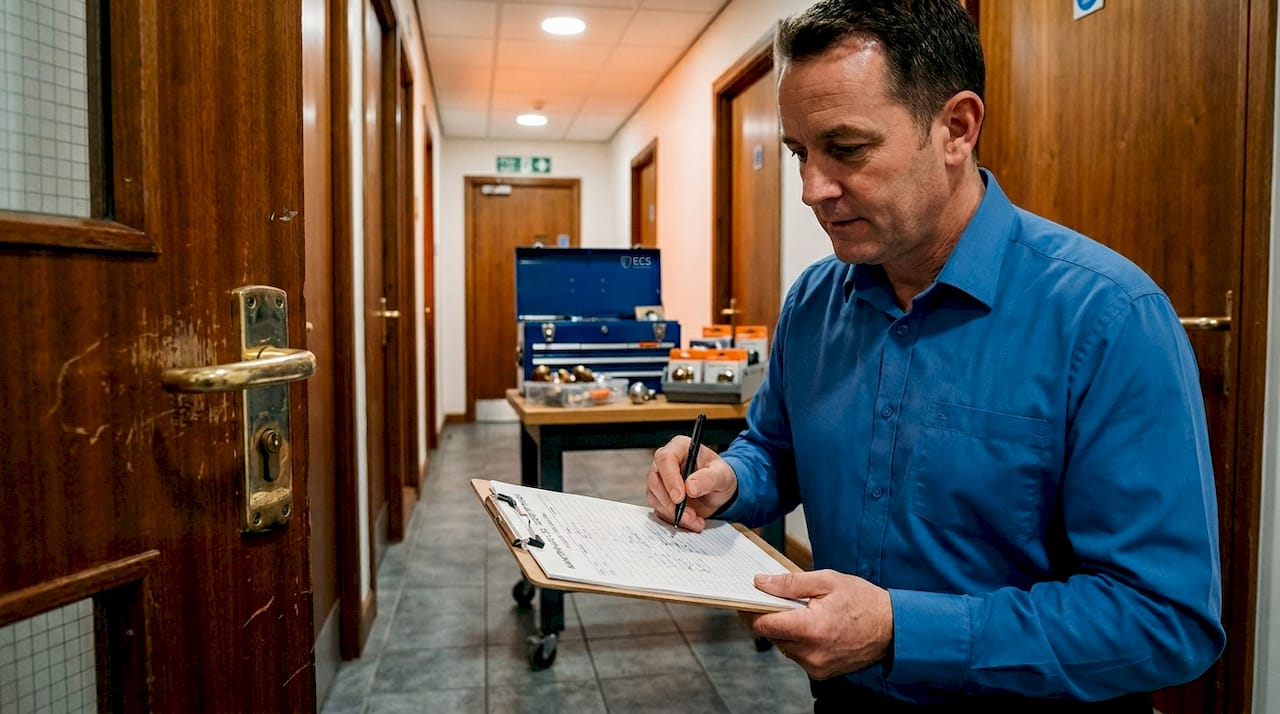
The main wear factors to account for include heavy usage cycles, temperature fluctuations that cause metal expansion and contraction, moisture and corrosion in external or poorly ventilated doors, and misalignment caused by door frame settling or heavy use. Any one of these can shorten a lock’s effective life significantly if left unaddressed.
Professional maintenance every 6 to 12 months is the standard recommendation for most commercial locks, with higher-traffic doors requiring more frequent attention. The table below gives a practical reference for how often different components should be checked.
| Component | Recommended check frequency | What to look for |
|---|---|---|
| Mechanical lock cylinder | Every 6 months | Stiffness, wear, corrosion |
| Strike plate and alignment | Every 6 months | Misalignment, loose fixings |
| Panic and egress hardware | Monthly | Release force, single-motion operation |
| Electronic lock components | Monthly | Error codes, response time, battery level |
| Wiring and network integration | Annually | Fraying, connection faults, firmware updates |
| Door closers and hinges | Every 6 months | Grinding, resistance, oil leakage |
Ignoring unusual noises such as grinding, clicking, or resistance when operating a lock is one of the fastest routes to an emergency replacement. These sounds are the hardware telling you something is wrong. Acting on them immediately saves the cost and disruption of a complete failure.
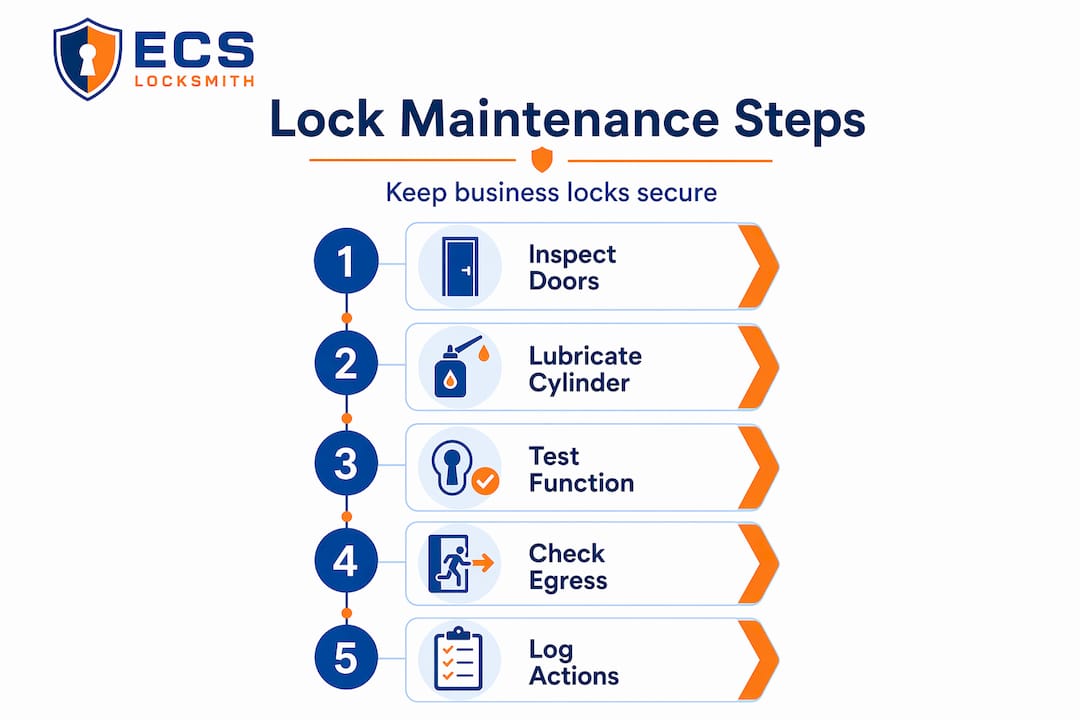
For electronic access controls specifically, servicing must include software and firmware updates, testing of backup power supplies, and checking network integration. These are not tasks that a general maintenance operative can handle. They require a locksmith or security technician with relevant experience.
Pro Tip: Keep a simple logbook for each external door noting the date of each inspection, what was found, and what was done. This record is invaluable for compliance audits and gives you early visibility of recurring issues.
Maintenance checklists that cover all relevant door hardware components help standardise what gets checked and ensure nothing is overlooked across a multi-door facility.
Lock types and what maintenance each requires
Not all commercial locks demand the same maintenance attention, and understanding the differences helps you allocate resources correctly.
Mechanical deadbolts and mortice locks are the most common and the most straightforward. They need periodic cylinder lubrication using a dry graphite or PTFE product, not oil-based lubricants which attract dirt, plus alignment checks and strike plate tightening.
Electronic locks and access control readers introduce complexity. Electric strikes tested to ANSI/BHMA A156.31 Grade 1 are rated for up to one million cycles, which equates to roughly 27 years at 100 operations per day. However, this lifespan assumes correct installation, regular wiring checks, and monthly testing. Without maintenance, failures occur far earlier and often without warning.
Panic hardware and fire exit devices deserve special attention because their failure has life-safety consequences. Beyond visual inspection:
- Test the full release sequence under load at least monthly
- Verify that a single forward push releases the door without excessive force
- Check that the device re-latches correctly after each use
- Confirm no supplemental locks or chains have been added by staff attempting to secure the door after hours
Failing panic hardware during an evacuation is not a hypothetical risk. It is a documented cause of preventable casualties in commercial fires. The importance of door lock maintenance at this level is not about convenience. It is about the difference between a safe exit and a blocked one.
Keypad and smart lock systems require battery management, firmware updates, and periodic re-calibration of electronic components. These systems also need testing after any power interruption to confirm they fail in the correct state, either locked or unlocked depending on the door’s function.
Practical steps for building a maintenance routine
Knowing that maintenance matters is one thing. Building a system that actually happens is another. Here is how to approach it practically:
- Audit every secure door on your premises. Create a simple inventory listing door location, lock type, last service date, and any outstanding issues. If you do not know what you have, you cannot maintain it properly.
- Set a routine inspection schedule. Monthly visual and functional checks for all doors, with a more thorough professional service every six months for standard-traffic doors and every three months for high-use entrances.
- Engage a qualified commercial locksmith. Look for a provider with experience in access control systems, knowledge of current egress codes, and 24/7 availability for emergencies. A locksmith who only handles residential work is not the right fit for a commercial facility.
- Keep maintenance records. Document every inspection, every repair, and every component replacement. This is your evidence of due diligence if an incident leads to an insurance claim or a compliance investigation.
- Budget for preventive maintenance explicitly. Many businesses only budget for emergency repairs, which are always more expensive. A planned service contract typically costs a fraction of a reactive callout followed by a lock replacement.
- Review after any incident or near miss. If a key breaks, a lock sticks badly, or an access control system fails, treat it as a trigger for a full inspection of that door and adjacent hardware.
For those scheduling regular commercial inspections, the difference between an ad hoc callout and a planned programme is significant, both in cost and in the consistency of your security posture.
My view on why this keeps getting overlooked
In my experience, the reason commercial lock maintenance gets deprioritised is not ignorance. Most property managers know it matters. The problem is that locks are invisible infrastructure. They work quietly in the background until they do not, and by then the cost is far higher than any maintenance programme would have been.
I have seen businesses spend thousands on emergency locksmith callouts, temporary security measures, and replacement hardware after a complete lock failure, when a scheduled six-monthly service would have identified the problem at the component level for a fraction of the cost. More seriously, I have seen egress hardware that looked fine visually but required nearly double the permitted release force to operate. That is a fire evacuation liability hiding in plain sight.
The businesses that get this right do not treat lock maintenance as a cost. They treat it as part of their security strategy, sitting alongside their alarm systems, CCTV, and access control policies. When you see it that way, the question is not whether you can afford to maintain your locks. It is whether you can afford not to.
Engaging a Dublin locksmith who understands commercial security and compliance requirements turns this from a recurring worry into a managed programme. That shift in approach is what separates reactive businesses from resilient ones.
— Barry
Keep your commercial locks in expert hands
If this article has prompted you to think about the current state of your commercial door locks, the next step is straightforward. Ecslocksmiths provides professional commercial locksmith services across Dublin, covering routine maintenance inspections, lock repairs, egress hardware servicing, access control system checks, and 24/7 emergency response.
Whether you need a one-off audit of your premises or a scheduled maintenance programme that keeps you compliant and secure throughout the year, the team at Ecslocksmiths has the technical knowledge and commercial experience to deliver it. We work with business owners and property managers who want reliable commercial lock support rather than the stress of dealing with failures after the fact. Contact Ecslocksmiths today for a free estimate and get your maintenance programme in place before a problem forces your hand.
FAQ
Why maintain commercial door locks at all?
Commercial locks degrade through daily use, environmental exposure, and mechanical wear. Regular maintenance prevents security failures, keeps egress hardware compliant with codes such as NFPA 101, and avoids costly emergency repairs.
How often should commercial door locks be serviced?
Professional servicing every 6 to 12 months is the standard for most commercial locks. High-traffic doors and egress devices with life-safety functions should be inspected and tested monthly.
What happens if egress hardware is not maintained?
Non-compliant or failing egress hardware can result in code violations, insurance complications, and genuine danger during evacuations. IBC 1010.2.9 standards require panic devices to release with no more than 15 pounds of force in a single motion.
Can I maintain commercial locks myself?
Basic visual checks and testing are something any property manager can do. However, cylinder lubrication, alignment adjustment, egress hardware compliance testing, and electronic access control servicing require a qualified commercial locksmith to be done correctly and safely.
What are the signs a commercial lock needs immediate attention?
Sticking or stiff keys, sluggish latch operation, visible corrosion, electronic error codes, and any door that does not close and latch reliably are all signals that immediate professional inspection is needed before the lock fails entirely.
Recommended
What services do locksmiths in Ireland actually offer?
It’s more than just unlocking doors. Most locksmiths provide:
Emergency lockouts (home, car, business)
Lock repairs and replacements
Key cutting and rekeying
Security upgrades (e.g. anti-snap locks)
Car key replacement
How quickly can you respond to an emergency?
In emergency situations, typical arrival times should be at your location within 20-30 minutes. There are always professional locksmiths on standby, ready to handle any lockout or security emergency, ensuring safety is never compromised.
Can a lockmsith help with high-security locks and systems?
Absolutely! Most locksmiths specialise in advanced high-security lock systems, including electronic locks, biometric security, smart locks, and keyless entry systems. The should be trained in the latest security technologies, ensuring that they can provide the highest level of protection for your home, office, or vehicle. Ask for a free expert consultation to help you choose the right security system for your needs.
Will a locksmith provide a warranty on there services?
Yes, all locksmiths should stand by the quality of there work and offer a 100% satisfaction guarantee. Most would by default offer a warranty on all services, ensuring that you receive the best craftsmanship and long-lasting results.
Can a locksmith open Cars
Yes, most locksmiths are trained to open cars.
How quickly can a locksmith get to me in an emergency?
Most locksmiths in Ireland offer 24/7 emergency callouts and typically arrive within 15–60 minutes, depending on your location and traffic. In Dublin, response times can be as fast as 10–30 minutes, especially for emergency lockouts.
Can a locksmith open my door without damaging it?
Yes A professional locksmiths use non-destructive entry methods first. Drilling is usually a last resort, not the default approach.
If someone immediately suggests drilling without inspecting the lock, that’s a red flag.
How much does a locksmith cost?
Costs vary depending on the service, time of day, and complexity of the job. A standard lockout is usually cheaper than replacing a lock. Emergency or late-night services may cost more.
Prices vary, but here’s a realistic guide:
Standard callout/labour: €85–€95
Lockout service: from ~€85–€120+
Lock replacement: depends on parts + labour
Important: Always ask for a full quote upfront and if there is a call out fee. Some companies advertise low prices but increase costs after arriving.
Prices can vary quite a bit… call around for quotes!
Can you make a key without the original?
Yes A professional locksmiths use non-destructive methods whenever possible. Damage usually only happens if the lock is faulty, high-security, or has already been tampered with.
Do locksmiths in Ireland need to be licensed?
Yes. In Ireland, all locksmiths must be licensed by the Private Security Authority (PSA).
If you’re hiring someone:
Ask for their PSA licence number
Avoid anyone who can’t prove credentials
By asking for the licence you avoid the scammers.
Providing Locksmith Services For More Than 30 Years in Dublin, lock outs, lock fitting, slam locks, car opening, commerical and domestic.


Quick Links
Home
About Us
Services
Testimonial
Faqs
Legal
Privacy Policy
Terms & Conditions